This is topic red or green illuminated reticle? in forum Night forum at The New Huntmastersbbs!.
To visit this topic, use this URL:
https://www.huntmastersbbs.com/cgi-bin/cgi-ubb/ultimatebb.cgi?ubb=get_topic;f=7;t=000066
Posted by Aznative (Member # 506) on December 08, 2012, 09:21 AM:
I remember talking to Jay Nissetter once and he told me about a texas hunt he went on using a trijicon reflex sight which has an amber illuminated reticle. He said the reticle just got washed out hunting under red lights and was useless. The reflex sight lacks any power adjustment so he couldn't turn it up to over power the red lights.
My question is would green be better at night under red lights or would red be ok if you could turn the brightness up? There is a better selection of red illuminated reticles than green.
I wonder which would be best in daylight?
Jay: I'm sorry if I misspelled you last name.
Posted by TA17Rem (Member # 794) on December 08, 2012, 10:10 AM:
I've used a Bushnell Halo site with red reticle at nite that worked well for me. The reticle was also adjustable..
Posted by Leonard (Member # 2) on December 08, 2012, 10:38 AM:
Yes, you did misspell Nistetter but he's probably used to it?
Forget about illuminated reticles, regardless of color. I'm assuming here that you are using some type of spotlight for illumination?
I much prefer a simple duplex. I don't like cluttered rangefinders, but several experienced night hunters that I know and respect like a very heavy duplex, which I don't find particularly useful, especially after sun up.
Good hunting. El Bee
Posted by Prune Picker (Member # 4107) on December 08, 2012, 11:23 AM:
AZ, the Trijicon Reflex is / was of an older design. Using tritium for illumination WITH OUT any battery('s). The design does work for what it was intended to do. But improvements in battery's, mounts & design kind of outdates it's one huge advantage, it stayed on for years and you could see the dot when the battery powered ones failed from a dead battery's or shitty quality or both.
But i, like some others use a lower powered (1.5x5, 1.75x6) scope and as LB said a std duplex and am happy when whatever artifical light is in use at night. Scope QUALITY and what you can afford or will spend is your best friend.
Posted by Leonard (Member # 2) on December 08, 2012, 12:00 PM:
I know a guy that had one of those and he said it worked better when the brightness had faded after some time, but I don't know how long it takes, some people have said 20 years?
Anyway, lighted reticles, I have two USO scopes with 11 position red reticles. Recently I was on stand well past dark, mainly because I had a coyote barking from well within 100 yards. I was going through a bunch of sounds, coyote vocalizations and prey sounds and he kept barking. Then I used a injured gray fox pup sound and he shut up.
I was sitting on a berm and I expected the coyote to come around the base of the hill and move in the direction of the caller. But it surprised me a little bit that I suddenly noticed a coyote standing on the berm, about 40/50 yards away and if not for the lack of vegetation on the berm, I would never have seen him at all, it was that dark.
I turned on the lighted reticle and pointed the scope in his direction and was blinded, I couldn't see a thing except red reticle. Now, with my night vision destroyed, I turned off the light and was in a bit of a hurry because I figured he could see everything I was doing, if not understanding what I was? So, I did the best I could, aiming at a blob I could barely make out and I really thought I made a solid hit but he wasn't there when I got up and walked down there.
Yeah, we found blood and bone and the guy I was with had a LED light which was a huge help but eventually, the trail dried up. He got away.
Conclusions. First, he probably died less than a quarter mile away. But if I had not been so smart and decided to use the lighted reticle, I might have been able to line up on him through the scope and make an accurate shot before being blinded by the light. Yes, I did have it cranked up to (I think) 4 which may have been the mistake, but the damage was done.
The lighted reticle is great for sniping at rag heads from behind a wall where you can dial in the right amount of intensity beforehand. But, if you don't know, and it's pitch dark without a moon, in my case it hurt, rather than helped and no telling how long that coyote was going to remain standing on the berm.
Good hunting. Lima Brav 0
Posted by Prune Picker (Member # 4107) on December 08, 2012, 12:43 PM:
LB, i am guilty of similar errors, but i love to hunt after dark (varmits). I have outsmarted myself many times looking for an edge only to have it spoil or go to shit at the moment of truth. Years ago when the first and second gen night vision came out i didn't jump because i had a better, trusted and proven (to me) way.
But when the third gen "stuff" showed up after the first Iraq war ended in 91 i went to the "surplus" store to look. Everything i used was hand held and i used it to locate then switch to the trijicon reflex or scope mounted rifle with ok results. But as i got older i adjusted my habits. I waited for a better moon and newer Brighter scopes and have stalled a bit. But i have a pretty good idea of the areas i hunt and "try" to use that as an advantage.
Posted by TA17Rem (Member # 794) on December 08, 2012, 03:04 PM:
Nothing like calling them under a full moon over snow you can see the reticle pretty good till you place it on a coyote then you have to guess or hope you have it in the right spot when pulling the trigger..
Posted by Prune Picker (Member # 4107) on December 08, 2012, 04:55 PM:
Tim, as long as they are moving but not running i think its easier to see and hit them at night. Not sure if i pay more attention or i get a better profile/outline of their body. I also think that is where the quality of the glass pays off. But most of all is a persons vision after dark.
Posted by TA17Rem (Member # 794) on December 08, 2012, 06:38 PM:
PP once they hit the 300 yd mark I can pick them up with the bino's or scope, what I see is pretty much just a dark form/shadow.
On a full moon night with snow on the ground you can see tree's on a half mile fence line with the naked eye and most people think if there was a coyote standing in the middle of the field it would be easey to pick out which is'nt so with out the aid of bino's... I'm useing what I would call a medium cross hair/reticle, it gets the job done but leaves you with a little bit of guessing.. Normaly what I have to do is aim in front or back of the coyote a foot or two so I can see the full cross hair for a short time and then swing into the coyote and shoot when the outter edge of the crosshairs line up or look right..
Posted by Prune Picker (Member # 4107) on December 08, 2012, 07:05 PM:
Tim , have you tried turning the power down on your scope, assuming you are using a variable power scope? For me less power is better sometimes but not always.
Posted by TA17Rem (Member # 794) on December 08, 2012, 07:33 PM:
PP. I have two rifles that are set up for night calling. One has a fixed 10x with 30mm tube and the other a 4.5-14 with 1 inch tube and power is set to 4.5... At the moument the 10x has worked the best for me as for clarity and field of view, lite gathering and I just feel more comfortable with it.
I think Leopold has a lited reticle that appears gold in color when turned on and this maybe a better choice but at the moument I have no plans to buy another scope and will just make due....
I did come up with a new way to use a red-lite (new to me) and plan to try it out first before I comment on it...
Posted by Prune Picker (Member # 4107) on December 08, 2012, 09:32 PM:
Tim i admit to being a Leupold fan, but when they first came out with an illuminated reticle scopes they were pure trouble. That may be why i don't care for them (illuminated scopes) today a dozen or so yrs later. I'm sure they have improved the newer ones but once bitten...
Are you using your red light mounted or is it hand held?
Posted by TA17Rem (Member # 794) on December 09, 2012, 12:30 AM:
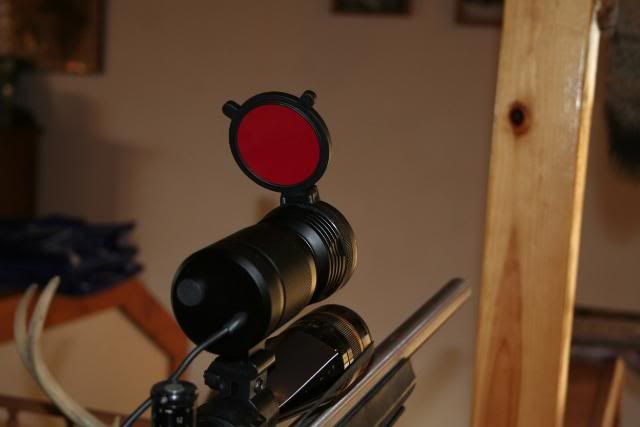
I have a few lights that I use, one is a hand held with a removeable red lens and the other mounts on a scope that also has a red lens cap that you can flip up with your thumb if you need to burn the target. The light for the scope can also be installed on a shotty. The light also has a manual/pressure switch to turn it on..
The coyotes I call to are close by so I can't have alot of equipement that weighs me down or makes alot of noise when carrying it to a stand.
The coyotes here are used to seeing yard lights from the farms and from cars and such so I may drag along another light and mount it 5-6 ft. up off the ground on a pole or even a tall wooden fence post with a red filter and just leave it on and see what happens.
As far as night calling with lites I'm new to this so I have to figure out what will work here for me and only have so many coyotes to do this with....
Posted by TA17Rem (Member # 794) on December 09, 2012, 12:36 AM:
PP some may have seen these lights I posted last year but anyway here they are again.. I really like both of them and they work well for me and no issues with them yet.. I liked the handheld so much I bought another one and also plan to get another one for the scope..You can get them from Cabela's

Posted by Aznative (Member # 506) on December 09, 2012, 07:50 AM:
Some of my best shots at both standing and running coyotes has been with a simple dot in daylight. I don't seem to do as well with a cluttered reticle especially when I'm in a hurry. That is the reason why I've been looking at illuminated reticles. Having zero experience with them, I've been thinking it would achieve the same focus point that the dot does and probably even more so. I never would have thought that a red illuminated reticle would cause one to his night vision. That is a real consideration. My thoughts were it would be nice to be on target when the burn light is turned on.
Posted by Leonard (Member # 2) on December 09, 2012, 09:07 AM:
You know what? Since you brought it up. The worst reticle for night hunting is a dot. You simply can't find it, it's lost in the clutter of the brush and rocks.
Good hunting. El Bee
Posted by Aznative (Member # 506) on December 09, 2012, 11:58 AM:
It looks like the dot is the best daytime reticle and the duplex or heavy duplex being the best at night at least for me. Illuminated reticles probably require a prior to use brightness check. That could be a problem on the first and last stand of the day as the light changes. I call with the rifle/shotgun on a bypod so adjusting the brightness would be possible with a minimum of movement. It just wouldn't be a good thing to do with a wary coyote within range.
I have a speed dot that I need to install on my shotgun. That would give me some experience with a red illuminated reticle. The main reason why I purchased it was because that benelli patterns so damn high shooting dead coyote.
I do like Leupold. I don't remember if I mentioned this but I'm thinking about getting one of the Leupold VX-R scopes in 1.25-4x. They all come with cluttered reticles with an illuminated dot at the center. The rest of the reticle stays black even when off. For some reason they all have a circle around the dot with several variations of duplex/crosshairs going thru the circle. I believe this illuminated dot would work as well as a dot in daylight as long as the brightness is set properly. They are fairly reasonably priced ranging from $450-$600 in this power range.
The only problem with the green reticle is it is only available in the "Zombie" model. I'm sick of this Zombie crap but if green is better, I'll consider it. The Zombie model is still a great Leupold VX-R scope that includes two different BDC dials which the standard VX-Rs don't have right out of the box.
BTW: My sister and niece gave me a $150 gift card to cabellas for achieving old fartdome, my 60th birthday. That is what started all of this.
[ December 09, 2012, 11:59 AM: Message edited by: Aznative ]
Posted by Leonard (Member # 2) on December 09, 2012, 12:37 PM:
I was just relating the one and only time I lined up on a coyote in pitch dark sky, with a lit reticle. Maybe it would have been okay on the lowest setting?
I know that with my EOTech on a normal day, I have to crank the intensity up to 6 or 7 before it really stands out for me.
Good hunting. LB
Posted by Prune Picker (Member # 4107) on December 09, 2012, 05:32 PM:
Az, If you are seeing different colored reticles on a non illuminated Leupold scope, it might not be focused for your eye?????? I am NOT positive but everyone that "I" have used has a black reticle WHEN focused for me. Hopefully i'm not misleading you. It might be worth contacting Leupold concerning this matter. Hope it helps.
Posted by Leonard (Member # 2) on December 09, 2012, 05:38 PM:
I think I have had Leupold scopes that had gold crosshairs?
Posted by Prune Picker (Member # 4107) on December 09, 2012, 06:05 PM:
I just took 3 leupold scoped rifles outside, but it's dark so i used a white L.E.D. flashlight to check. They are black. Maybe a different colored light will change the color? The scopes are all vari x 3 or vxIII's in 1.5 x 5, 1.75 x 6, 2.5 x 8
Posted by TA17Rem (Member # 794) on December 09, 2012, 08:53 PM:
Leupold's do have a gold reticle.. If you look through the scope and don't have your eye centered it willbe gold but once you center your eye it will become black.. I also noticed if you have a brite light shinning above you and just a little behind it will also show up gold...
Posted by Prune Picker (Member # 4107) on December 09, 2012, 09:33 PM:
Yeah that sounds better than what i was saying and thinking Tim. And thanks for posting the pics of your lights.
Posted by TA17Rem (Member # 794) on December 09, 2012, 10:06 PM:
Anytime... I like Leonards flipper lights better but not all of us can afford those high dollar lights. ![[Wink]](wink.gif)
Would be nice if Leonard could come up with a more mobile and compact flipper light.. Hell we could even give him credit for the idea. ![[Big Grin]](biggrin.gif)
Posted by Leonard (Member # 2) on December 09, 2012, 11:48 PM:
Just the ravings of an old coot, I was just kidding about the gold and don't know what the hell TA is talking about? Flippers? Somebody's dreaming.
Good hunting. Lima Bravo
Posted by Aznative (Member # 506) on December 10, 2012, 06:18 AM:
I have a Vari X-3 that has reticles that look gold colored under dim lights. The rest of my Leupolds look black.
Posted by knockemdown (Member # 3588) on December 10, 2012, 08:52 AM:
If a scope's reticle looks 'gold' under different light conditions, its prolly cuz the reticle is made of wire.
Glass etched reticles will always appear black.
I prefer red illumination over green. Some of today's higher end scopes have their illumination range set very low, so as to be compatable with NV gear. There is no washing out of reticle color under normal vision, even on the highest setting.
Premier's Gen II mildot in first focal plane is wonderful after dark. Only the center + shape of the reticle is illuminated. So, on low power, your eye perceives a single dim red dot.
Thanks to the FFP design, when you crank up the magnification, the + shape becomes evident and allows for a precise hold, even on a tiny gray fox. And again, the brightness cranked to max is not enough to wash out your target.
Outer posts are thick enough to stand out against dark backgrounds, and the Premier's glass is nothing short of outstanding. In a 3-15X power range, the Gen II mildot is the bomb diggity...
(not my pic) 
Posted by Leonard (Member # 2) on December 10, 2012, 11:18 AM:
Yes, that would be my opinion, the gold color is because it's a flat wire with the center twisted 90˚ to form the fine crosshairs. Anyway, that's what it looks like, to me?
As far as the best illuminated reticles are concerned, and as far as I am concerned, they are a waste of time. I never needed them in 40 years, and I see no advantage, at all?
Good hunting. LB
Posted by knockemdown (Member # 3588) on December 10, 2012, 11:43 AM:
I've got two 3-15x50 Premiers, same glass same Gen II reticle, but only one has the lit reticle option. I like the lit reticle more better-er for night calling...
Posted by Leonard (Member # 2) on December 10, 2012, 12:33 PM:
Fred, are you calling at night with a spotlight?
I am completely serious, and I cut my teeth night hunting. For quite a while, day stands were a relatively minor part of a hunt, picking a number out of a hat, maybe 25% day stands on a hunt starting on a Friday night and ending late Sunday afternoon. That's a lot of time and treasure invested and I never felt handicapped in the slightest, without a lit reticle.
I KNOW a lighted reticle is not necessary to be successful hunting at night and I can back it up with several decades of experience and killed more coyotes than Tony Tebbe has "called" in his entire lifetime.
If it works for you, I say that's great; but it's just about the most unimportant gear a guy needs to kill coyotes, at night. Not because I have used it a lot, but because I have done a lot of this stuff and managed without, for many years, long before they were invented.
I might be a stubborn old fossil and opinionated as most fossils are, but I am convince we don't need a thousand dollar lit reticle to kill coyotes at night.
Good hunting. El Bee
Posted by knockemdown (Member # 3588) on December 10, 2012, 01:50 PM:
Yep, but I'm on foot, using a small red LED torch, or my Streamlight Ultrastinger with red lens.
Hunting from any vehicle is illegal here, so I've gotta carry all my shit, and don't have the luxury of a mobile elevated shooting position with constant 12V to run giant aircraft landing lights all night long. Essentially, I'm working with alot less light, but I do have the benefit of hunting over snow mostly after December. Snow helps bigtime, as does excellent glass & an illuminated reticle to stand out better against a more dimly lit target...
I know you da man regarding night calling from a rig, Leonard. That's something I'd LOVE to try sometime! But hell, I can't even lean against my ATV or plug a portable light into the 12V socket. Both are considered "hunting from a vehicle" here in NY, so I just stumble my azz around 1/2 the night, carrying as little as possible to kill sumthin'...
I don't dispute you not needing an lit reticle, at all. But it does help me acquire & connect in front of my LED torch.
Watch this stupid video, this is how I hunt
[ December 10, 2012, 01:53 PM: Message edited by: knockemdown ]
Posted by Leonard (Member # 2) on December 10, 2012, 02:58 PM:
Is that your video, Fred?
First of all, we both know there is no comparison between a gray fox and a coyote. There has been a conversation this morning about how stupid cats are. Gray fox are, (how to say this?) much less cautious . In fact, we will routinely ignore a fox rather than potentially queer a stand by killing a gray until we are ready to break off the stand. Because, they are usually still there, and it's an option, sometimes we might want them and other times we just ignore them much like coons. I hardly feel like wasting a bullet on a coon, but a gray is worth points in our system so we kill them if it's not a coyote only contest hunt.
Second, if that's you, it looks like you are holding the light beneath the eyes, rather than above the eyes? I promise you, a coyote is far less inclined to approach a stand with the path lit up, in front of him. Maybe that's not what it looks like, can't tell, but it is a no no for seasoned night hunters to hold a light anywhere but above the eyes.
Third, (and I'm really not picking apart your video, it's cool) but, with a gray, or a cat and a red light, you do not have to hold the light anywhere but directly on the animal, because they are not light shy at all. In other words, holding the eyes in the halo under a light is by far the best technique for handling coyotes, and any animal you have not identified. But when you know what it is, I just hold the light right on a fox or a cat, they aren't going anyplace.
The odds of killing a called fox or cat, at night are perhaps three times better than a coyote, where anything can happen. A coyote doesn't allow very many mistakes, whereas, I have piled grays and kit fox one on top of another, three high, literally. At night. Calling and killing a kit fox in the daytime is one of the rarest events you will ever see. I think they are in dens and hardly ever come out until dark, I just don't see them until after dark.
Here's my opinion on hunting at night, on the ground. I don't think I would bother, it's too much trouble. These laws about "attached to a vehicle" are kind of retarded. I mean, I can understand they need something for the assholes that spotlight deer but laws concerning the hunting of predators is not justified. There is so much speculation and worry and concern about hunting at night, and almost none of it is justified. But, they sure like to regulate, don't they?
Good hunting. El Bee
[ December 10, 2012, 02:59 PM: Message edited by: Leonard ]
Posted by knockemdown (Member # 3588) on December 10, 2012, 04:51 PM:
Yep, that was me this past year, Leonard. I was goofin' around and made a monopod contraption to swing both my flashlight and a handicam at the same time...

Since it's only a monopod, and I'm sitting on my azz, it's not the most steady way to swing a light. But, it's been pretty cool to mess with. As for shining low/high on the critter, I shine wherever it takes for me to see that fawker in my scope ![[Smile]](smile.gif) Considering the paltry amount of lumens a handheld flashlight throws, I haven't seen much in the way of critters spooking with a face full of light beam.
Considering the paltry amount of lumens a handheld flashlight throws, I haven't seen much in the way of critters spooking with a face full of light beam.
Yep, those grays are dumb as shit, but I've had coyotes come bouncing in at night with more vigor and less apprehension than any fox. That may be more due to their more aggressive response to a chosen sound, but in any event, the flashlight beam don't seem to bother them?
I'll be trying to get a coyote kilt on this camera doohickey pretty soon.
And thanks for the light angle advice. Any tips that will make be more successful are definitely appreciated!
Posted by TA17Rem (Member # 794) on December 10, 2012, 05:12 PM:
quote:
it looks like you are holding the light beneath the eyes, rather than above the eyes? I promise you, a coyote is far less inclined to approach a stand with the path lit up, in front of him.
I'm guilty of this.. I had coyotes spooking most every stand last season and then leonard tossed out a gold nuget telling me to keep the lite up higher so the coyote is in the bottom of the halo.
That advice helped alot on my stands but they are still a little difficult to bring in over snow with a lite and in most cases I'm better off without it when there is snow on the ground and I have a full moon..
The lighted reticle maybe the answer for calling over snow with a full moon and no lights but for me that will have to wait..
Posted by Leonard (Member # 2) on December 10, 2012, 05:39 PM:
Well, you have a lot of conditions, Tim. It may very well be that wide open terrain, full moon it is probably better to leave the light off. I can see where a lot of sparkly snow could cause a coyote to check up. But, if you were hunting heavier cover without a moon overhead, unless it's one of those nights where they run right in your lap, you are far better off with a wide, red foglight. I don't like to hunt with a pencil beam spotlight. It's too easy to miss a set of eyes unless you put the beam right on them and this requires very busy light work. Up and down and checking gullies and hillsides, it's all very intent but with a wide beam and scanned slowly, you see everything and spook nothing.
Even the famous flipper light has a distinct disadvantage because it's still a tight beam, when you have the red lens in place and it does a bit of queering an animal because of all the movement and besides that, it takes so long to cover everything that they can easily blast in behind you. Yet, a flipper with a wide angle fog is very restrictive for identifying and burning when the animal is still out there at 100 yards and it's apparent that he isn't coming closer. That's why I use a dual light with both a pencil and a fog and switch between them instantly because I'm careful to calibrate both beams to the exact same place before I lock them in place. This is the best of both worlds, a little heavier but worth it. Superposed is better than side by side, I've seen both, have no use for SXS.
Good hunting. El Bee
edit: and, I read an article in Predator Extreme a couple weeks ago that pissed me off. They were claiming that coyotes come in just peachy under white light, a whole light bar with enough illumination to land a jet on an aircraft carrier. Yeah right, behind locked gates with virgin coyotes. For the rest of us, there is no substitute for red light. And, anybody that says otherwise is full of shit.
[ December 10, 2012, 05:45 PM: Message edited by: Leonard ]
Posted by TA17Rem (Member # 794) on December 10, 2012, 06:31 PM:
Oh we have some heavey cover here which ranges in size from a football field to as much as a 1/4 section, 1/2 section.. Only problem is the coyote is in it and there is no way you can get close to them by walking on snow.. I usually park down the road a ways then walk down it till I feel I'm close enough with out the coyote hearing me or I will set up along a tree line or drifted fence line that goes to the heavey cover.. A little wind even helps at times or some nearby traffic to cover up sounds from walking in.. It tough here thats for sure....
Posted by Aznative (Member # 506) on December 12, 2012, 11:36 AM:
Tim it sounds like your night hunting regs are almost as bad as Arizona's.
Posted by TA17Rem (Member # 794) on December 12, 2012, 12:07 PM:
Our reg.s are'nt to bad if you have to have a set of rules. The thing is when they came out with the new lite law they got confused and required us to use a light with a shotty and not the rifle when it should of been the other way around.. If they are close enough for the shotty you should be able to see them without a light, right? LOL
Well there is a hole in the reg.s so I plan to take advantage of it this season and see what happens...
Posted by Krustyklimber (Member # 72) on December 12, 2012, 12:53 PM:
K "I know you da man regarding night calling from a rig, Leonard."
Leonard actually has a really cool system for ground hunting at night, too... but I've been sworn to secrecy. ![[Razz]](tongue.gif)
Krusty
Posted by Prune Picker (Member # 4107) on December 12, 2012, 04:43 PM:
Guys if you are using the streamlight Stinger and or Ultra Stingers with xeon bulbs i found a valid LED upgrade kit that is well worth the cost. Terra Lux makes the kits and swps.com sells them plus several different lights and extras. I buy my cr123 batteries there also.
Posted by knockemdown (Member # 3588) on December 13, 2012, 10:09 AM:
Thanks for that info, PP!
I've got two Ultras, and a constant 12V charger mounted in my truck. When I use one, the other goes on the charger.
Just ordered an LED upgrade to compare against a stock Xenon bulb. This little LED torch I've been using was a bit brighter, so the Ultras have been on backup detail...
Appreciate the tip!
[ December 13, 2012, 10:13 AM: Message edited by: knockemdown ]
Posted by Prune Picker (Member # 4107) on December 13, 2012, 11:27 AM:
I haven't compared them to the factory ultra'a with LED. BUT my factory xenon bulbs "stuff" went straight into the trash when the conversion kits got here. And the battery charge claim is valid, on my lights.
Posted by knockemdown (Member # 3588) on December 19, 2012, 06:03 AM:
Just got the LED upgrade popped in the Ultra. Definitely an improvement over stock Xenon!!!
Thanks again for that tip, PP...
Posted by bucknertid (Member # 4301) on January 18, 2013, 09:55 AM:
Myself too have used a Bushnell Halo site with red reticle at nite that worked well for me.Its a mice experience to test.
Posted by bucknertid (Member # 4301) on January 19, 2013, 08:04 AM:
I think green would be better at night under red lights then red.The brightness does matter and has its clear impact.
Posted by Frank (Member # 6) on January 22, 2013, 10:17 PM:
Been using a Trijicon 3x9X56mm rifle scope for years. You can't get them anymore.
It has four different lighted reticles. One is a reticle lighted by ambient light. You turn a selector on the back of the scope kind of like you're adjusting parallax. There's an amber plastic lens which collects ambient light and illuminates the reticle.
Another turn of the back piece gives you an amber reticle illuminated by tritium.....a radioactive byproduct from nuclear reactors.
Another turn gives you a red reticle illuminated by the same tritium source.
Another turn gives you a green reticle illuminated by the same tritium element.
The green is fairly bright so it's best to use this when there's snow on the ground or a brighter background.
The red is best only for the lowest lighting conditions.
The amber is best for all around use and what I used almost 99% of the time.
I almost never used red or green illumination.
I've used some battery powered lighted reticle scopes and found the illumination too bright even on the lowest settings. At the time I concluded the scope manufacturers were on the right track but had no real world experiences as the settings they provided were always too bright.
For the Trijicon, the amber seemed best for almost all lighting conditions at night.....not too bright, not too dim.
One vital trick is to keep the guy lighting in front of the scope eyepiece. If the lighter got the light behind the shooter then all illumination was washed out by the lighter.
As long as the light was in front of the shooter the illuminated reticles provided a contrast to the background as seen in the scope. Shots could easily be made due to the good contrast of the amber reticle.
Unlike un-illuminated crosshairs, you could always make out the crosshairs and make the shot even on a dim set of eyes.
Here is where a word of caution should be spoken. Some animals eyes reflect poorly, like a cow for example. With the illuminated crosshairs, there will be enough contrast to make a shot on a dim or long range set of eyes possible. The 56mm objective collected lots of light. You could, most times, judge the distance to an animal by the distance between their eyes. If the lighter doesn't know what he's doing you'll likely let a round go in the heat of the moment on an unintended target. Never shoot at only one eye. Predators will have both eyes visible most times. If you see only one eye then don't shoot as it's not likely a predator.
With black crosshairs there often were times where you could not see the black crosshairs against a darker background. You lost the target as a result.
The illuminated crosshairs eliminated the loss of black crosshairs being hard to see when lighting.
When I sent the scope to Trijicon to replace the tritium element the brightness of the crosshairs increased to like new. I bought the scope in 1988 and it had lost allot of brightness in that time. I was refreshing when I got it back as I was starting to use the green illumination designed for more brighter backgrounds.
Here's a link to a pic of a rifle with the 3x9x56 mounted on it: http://www.bing.com/images/search?q=tri jicon+3x9x56&FORM=HDRSC2#view=detail&id=CBD8F4CDD4F7919487917CA2BF118ACC207E7146&selectedIndex=1
Here's a close-up of the backpeice. Notice the green button? This setting gives you the green crosshairs. On the other side are a red and amber button giving you red and amber illumination. The plastic, pill shapped bump was for coeelcting ambient light to illuminate the crosshairs:
http://www.bing.com/images/search?q=trijicon+3x9x56&FORM=HDRSC2#view=detail&id=CBD8F4CDD4F791948791E2F1864B874B7078251F&selectedIndex=3
[ January 22, 2013, 10:27 PM: Message edited by: Frank ]

UBB.classicTM
6.3.0